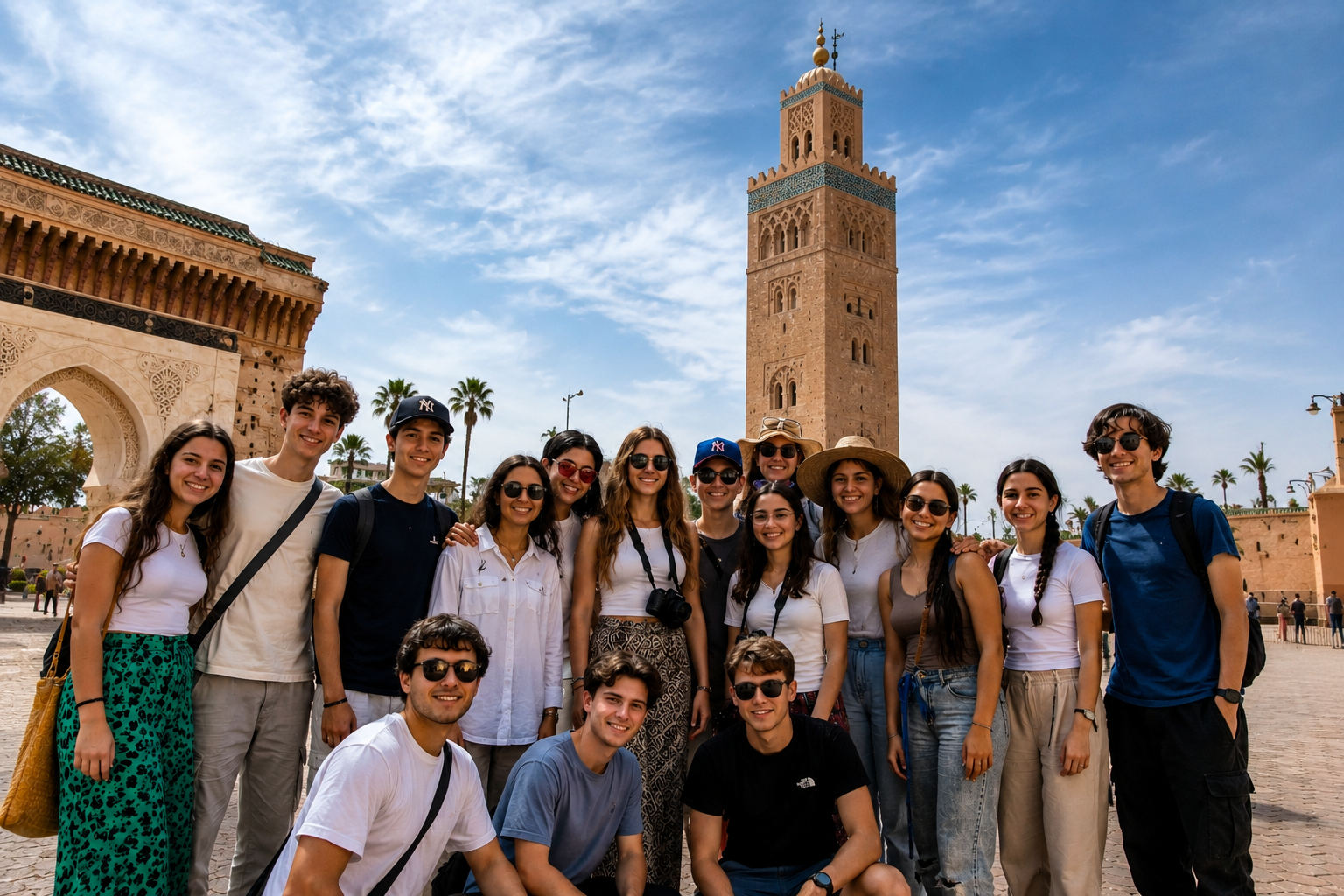

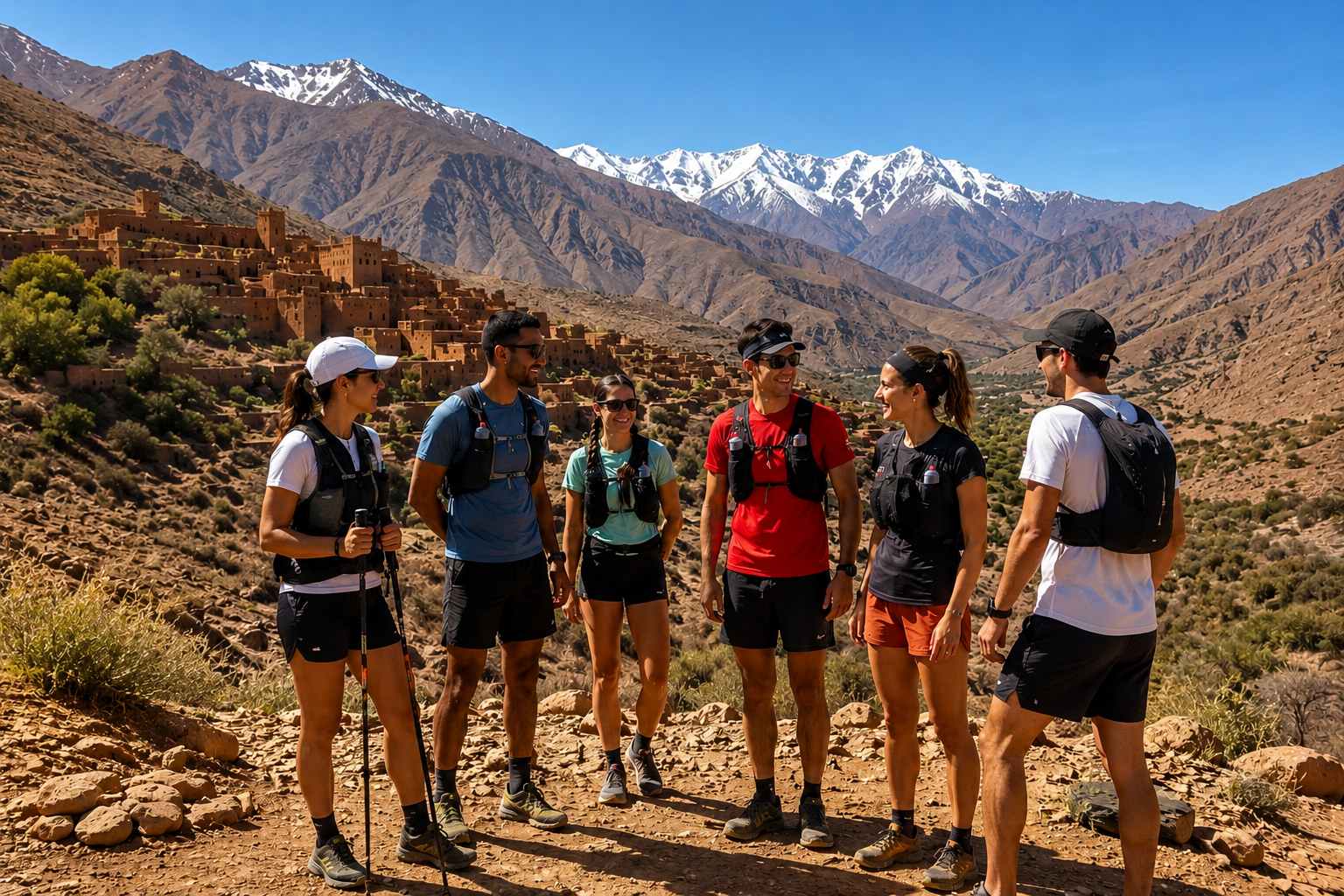
In January, while training pitches across the UK, Germany and Scandinavia are frozen or waterlogged, footballers in Marrakech are training in shorts under a warm sun, with the snow-capped Atlas mountains on the horizon. That single image explains much of why sports tourism in Morocco has grown so quickly over the past decade, and why professional clubs, semi-professional teams, youth academies and even national federations now build Morocco into their annual training calendar.
I am Nourddine, founder of Trek Morocco Desert. I was born here, I have spent my working life organising travel across every region of this country, and in recent years an increasing share of that work has been for sports groups: arranging pitches, hotels, transport, friendly matches and recovery days for visiting teams. This article explains what Morocco actually offers a travelling squad, from climate and altitude to facilities and cost, so that coaches, managers and club administrators can judge whether a Moroccan training camp fits their season.
Winter Sun, Altitude and Geography Built for Training
The first advantage is the simplest one: the weather. Between November and March, when most European teams need a mid-season camp, Marrakech and Agadir offer daytime temperatures of 18 to 25 degrees, very little rain and reliable sunshine. Agadir on the Atlantic coast is particularly stable, which is why it has long been a favourite of European clubs for winter preparation. Pitches stay firm, sessions run on schedule, and players train in conditions that let coaches work on intensity rather than survival. For pre-season in July and August, the coast stays temperate while inland cities heat up, so summer camps are based in Agadir, Essaouira or the cooler Atlas foothills.
The second advantage is one many clubs discover later: altitude. The town of Ifrane in the Middle Atlas sits at around 1,650 metres, surrounded by cedar forests, with a climate closer to Switzerland than to the Sahara. Moroccan federations and East African distance runners have used this region for altitude preparation for years, and it gives visiting teams the option of a genuine altitude block without flying to Kenya or the Alps. Within a three-hour drive you can move from sea level to real mountain elevation, which is a rare combination anywhere in the world.
Geography also solves the logistics problem that ruins many training camps: distance. Morocco is three hours from London, two from Madrid, and served by direct budget and national carriers into Marrakech, Agadir, Casablanca and Fes. A club can leave home on Monday morning and be on the training pitch by Monday evening, with no long-haul recovery cost and minimal time-zone change (Morocco runs on GMT or GMT+1, so there is effectively no jet lag for European squads).
Facilities, Football Culture and Value for Money
Morocco has invested enormously in sports infrastructure. The country hosted the Africa Cup of Nations across six cities in the winter of 2025 to 2026 and is preparing to co-host the 2030 FIFA World Cup with Spain and Portugal, and that investment is visible on the ground: renovated stadiums, new hybrid pitches, modern dressing rooms and improved transport links between host cities. The Mohammed VI Football Complex near Rabat, the national federation’s training centre, is regarded as one of the finest football facilities in Africa, and a growing network of quality pitches in Marrakech, Agadir, Casablanca and Rabat is available for visiting teams to hire, from natural grass to latest-generation artificial surfaces.
Just as important for a travelling squad is what surrounds the pitch. Morocco’s four and five star hotels understand group sport: buffet menus can be adapted to a nutritionist’s plan, meeting rooms become video-analysis rooms, and many resorts in Marrakech and Agadir have their own pools, gyms and spa facilities for recovery sessions. Halal catering is standard everywhere, which simplifies life for squads with Muslim players, and hammam-based recovery is a genuinely Moroccan addition that players tend to remember. For friendly matches, we arrange opposition through local clubs at the level you request, from regional amateur sides to professional academies, with referees, water and basic medical cover organised in advance.
Then there is the budget. A full-board training camp in Morocco, including four star accommodation, pitch hire, internal transport and staff, typically costs significantly less than an equivalent camp in Spain, Portugal or Turkey, especially in January and February when Moroccan hotel rates are gentle and European winter-sun destinations are charging peak prices. For semi-professional clubs, university teams and academies working with tight budgets, that difference often decides whether a proper camp happens at all. And because the country is compact, rest-day culture comes free: a squad based in Marrakech can spend its day off in the Agafay desert, quad biking over lunar hills and eating dinner in a Berber camp, which does more for team spirit than any hotel games room.
Beyond football, the same logic applies to other sports. Cyclists use the Atlas climbs in spring, runners train in Ifrane, triathletes combine Agadir’s ocean and roads, and golf teams work through Marrakech’s championship courses. Surf camps at Taghazout host national squads through the winter swells. Morocco is not a single-sport destination: it is a climate, a geography and a price point that serve almost any discipline.
How We Organise Team Training Camps
Trek Morocco Desert works as your local ground operator. You tell us your sport, squad size, dates, training requirements and budget, and we build the camp around them: airport transfers in modern coaches, hotel selection and menu planning, pitch or facility booking with the surfaces and slots your coaches specify, friendly match organisation, recovery activities and a rest-day programme. I remain your single point of contact throughout, available by phone at any hour during the camp, and a member of our team accompanies the group on the ground each day. We handle the country so your staff can handle the sport.
Planning your next training camp? Send me your dates, squad size and training requirements, and I will send you a detailed proposal with facilities, hotels and a transparent all-in price within 48 hours. Message us on WhatsApp, call us, or use the contact form below, and give your team a camp they will still be talking about at the end of the season.